

Nutcrackers are very interesting items, a combination of pragmatically useful and richly cultural history. Nutcrackers have a long history, whether they are the shiny metal kitchen drawer tools or the ornamental wooden dolls on the mantelpiece, they have a long history that extends centuries. This article discusses what nutcrackers are in fact, how they evolved, why they became so symbolic, particularly, at Christmas, and how they still remain suggestive today.
What Are Nutcrackers?

It is a device known as nutcrackers that crack hard shells of nuts. They were originally simple utilitarian, mere devices that were designed to aid people in gaining access to the tasty kernels that were contained within the walnuts, hazelnuts, and other nuts. There are still a few modern nutcrackers that do take on that role, although others have become purely decorative characters.
The broad definition is merely that a nutcracker is a mechanical nut-cracker breaker, however, the mechanism by which it works may differ radically depending on the design.
The Mechanics Behind Nutcrackers
There are some common types of nutcrackers, each being based on some other working principle. A typical type of it is the lever-action nutcracker, which functions the same as a pair of pliers: you put the nut into the jaws, press the handles, and the force breaks the shell.
The other design is a screw design: in this one you insert the nut into a little chamber, after which you force the screw with threads down upon the nut until sufficient pressure is produced to smash the shell. It is a more controlled cracking technique and it comes in when you particularly do not want to destroy the kernel inside. KnowledgeReason describes the fact that rotational motion is converted into linear force to apply high pressure on the nut by turning the screw.
Spring-loaded nutcrackers, more typical of the kitchen sets in modern days, are also available, and they use the force of a spring in reserve.
A Brief History of Nutcrackers
The nutcrackers have an extended history with a surprisingly rich one. The Leavenworth Nutcracker Museum indicates that the use of stones to crack nuts was as old as 4,000 to 8,000 years ago. With the improvement of the technology the first metal nutcrackers started to emerge. According to the museum, the oldest known dates of metal nutcracker are the third and fourth century B.C.
Metal nutcrackers in the form of levers were widespread by the Middle Ages and could be made of bronze or iron. Wood carvers in other parts of the world, such as France and England and in particular in the Ore Mountains of Germany started to make of wood nutcrackers.
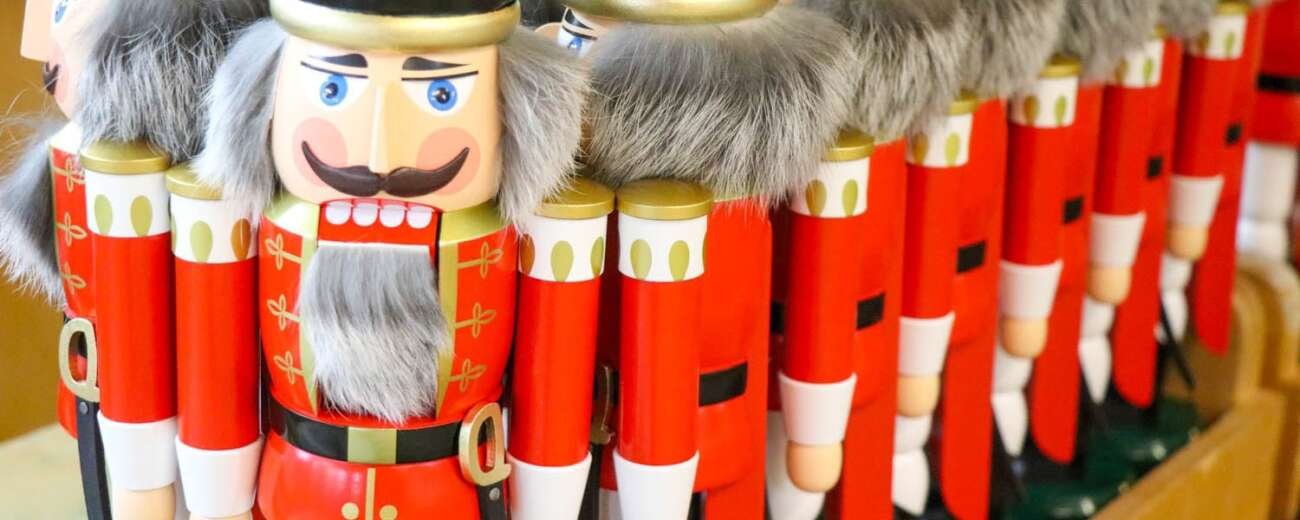
The figure nutcracker, a soldier, king or other character is the very recognizable one that originated in the Erzgebirge (Ore Mountains) of Germany. Around the end of the 19th century, Wilhelm Fuchtner headed the first commercial production of these wooden nutcracker dolls.
Nutcrackers & Christmas: How They Became Icons

The nutcrackers nowadays are an inseparable part of Christmas tradition and the association of nutcrackers with the holiday itself is a comparatively recent development. Nutcrackers were not in the business of Christmas and the decorative nutcracker dolls were made by the German woodcarvers of the Ore Mountains.
The fame of nutcrackers increased with the story The Nutcracker and the Mouse King by E. T. A. Hoffmann in 1816 and the ballet The Nutcracker by Tchaikovsky that was first performed in 1892. The decorative nutcrack figure became popular with the increase in popularity of the ballet. The wooden nutcrackers were also introduced by the American soldiers who come home in Germany after the Second World War and they were given to their home as a present, and they had already become a part of the Christmas culture.
Another folk belief is that the nutcrackers are a source of good fortune, protection and can keep off evil spirits in Germany.
Decorative Nutcracker Dolls
Nutcracker dolls, such as we know them, most commonly painted soldier or king, are no longer so functional. National Geographic reveals that a lot of these nutcrackers are not designed to crack nuts. These figures are generally present in a more ornamental form than their classic counterparts in which there is a lever on the back that allows the figure to open its mouth.
These characters are frequently sculpted and painted with attention and have a heavy touch of tradition. Their designs are a representation of folk art of Ore mountains where toy making and wood carving became a key cultural practice.
Functional Nutcracker Tools Today
Although most nutcrackers are ornamental, practical items are still in use in the kitchen. Innovations in nutcrackers are made of tough metals or hard materials in strong and ergonomic designs that break tough shells easily.
There are also kitchen nutcrackers that are intended to break the shell of lobster or crab, as they have hard outer shells. There are other home nutcrackers that give you the exact control like screw-type types that allow you to crack a shell without crushing the kernel inside.
There is still innovation among manufacturers where manufacturers make nutcrackers that have enhanced grip, adjustable compression and wear-resistant materials.
Collecting Nutcrackers: A Beloved Hobby
Nutcracker-gathering is something the many like. The valuable antique nutcrackers, especially the wooden or metal ones, are much in demand by the world collectors.
There is, for example, the Leavenworth Nutcracker Museum, which is devoted solely to nutcrackers. It has one of the biggest collections in the world, thousands of nutcrackers of the various periods and styles.
The great craftsmanship and stories behind each work are valued by the collectors. The construction of a nutcracker is often based on a certain time, location, or cultural practice regardless of whether the nutcracker is practical or purely decorative.
Symbolism and Folklore
Nutcrackers are also symbolic in addition to their practical use. According to the German folklore, they confer power and protection. They look like soldiers and thus are an automatic representation of protection, protectors of a home.
Due to the historicity of their origins and aesthetic qualities, nutcrackers have also gained a symbolism of the magic of childhood, holidays and nostalgia. The fact that they are associated to The Nutcracker ballet adds to this emotional resonance, which makes them closely connected to Christmas traditions in most parts of the world.
Caring for Nutcrackers
In case you have a decorative nutcracker, in particular, an antique or a wooden one, you should take good care of it. Remember to store it in a stable climate and dry place so that it is not damaged due to humidity or cracking. Blot it without rubbing it off and not in the sun which is known to bleach the paint.
To keep functional nutcrackers in shape, it is easier to rinse, dry, and keep them in a secure place. The screw mechanism could be attached to it, in this case, lubricating it occasionally could be beneficial to prevent its malfunction.
Why Nutcrackers Still Matter
What makes nutcrackers popular even nowadays is the fact that they provide a link between the utility and art as well as tradition. A contemporary kitchen still has a purpose of a functional nutcracker. A decorative nutcracker hanging on a mantelpiece warmly, nostalgically, and even with magic.
Nutcrackers are generational and their meaning changes between generation collectors and families. They can be used as a symbol of heritage, artistry or even holiday happiness. And they remain a visual abbreviation of power, defense and party atmosphere.
Frequently Asked Questions (FAQs)
How did the nutcracker figure get its origin?
The old traditional nutcracker doll was produced in the Ore Mountains (Erzgebirge) of Germany. There wood carvers started making nutcrackers with the shape of a soldier, king and other characters during the 18 th and 19 th centuries.
Did the nutcrackers always resemble decorations?
No. Nutcrackers were initially used as simple functional items either of metal or wood. With time, carvers started to make wooden ones that resembled people or animals.
Do the contemporary decorative nutcrackers crack nuts?
The decorative nutcrackers that are being produced nowadays are not created to crack nuts. As National Geographic says, most of them are exhibited and not used.
What is the reason why nutcrackers are related to Christmas?
Their connection to Christmas came with the story The Nutcracker and the Mouse King by E.T.A. Hoffmann and the ballet The Nutcracker by Tchaikovsky that was first premiered in 1892. In addition, nutcrackers have been exchanged as Christmas presents and carried by soldiers who went back to Germany and this further cemented their position in the holiday tradition.
Is it possible to make nutcrackers worth collecting?
Yes, particularly, the old or carved nutcrackers. The market of collectors is very strong, and the wooden or metal nutcrackers of these kinds are highly valued, and thousands of old artifacts are stored in such institutions as the Leavenworth Nutcracker Museum.





Leave a Comment